
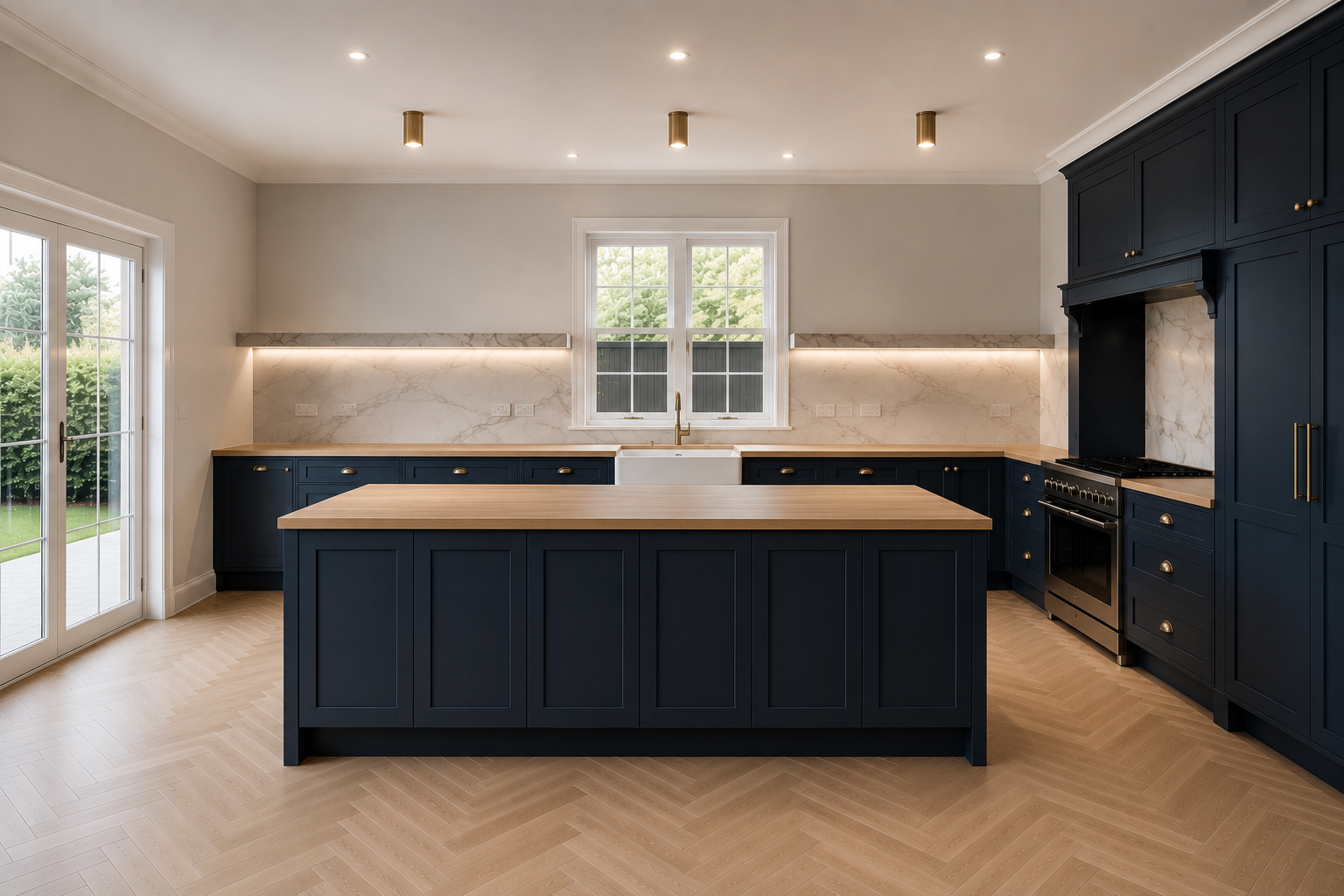
One of the first questions homeowners ask when planning a new kitchen is: "How much should we budget?"
It is a sensible place to start, but it is also a difficult question to answer without understanding the space, layout, materials and level of customisation involved.
As a general guide, a complete kitchen renovation in Melbourne may cost anywhere from around $25,000 for a relatively straightforward project to more than $80,000 for a large, highly customised kitchen.
For many homeowners looking for quality custom cabinetry, a considered design and professional installation, a more realistic starting budget is often between $40,000 and $70,000.
These figures are only a guide. Two kitchens of a similar size can have very different costs depending on their cabinetry, benchtops, internal storage, appliances and building work.
This article explains what affects the cost of a custom kitchen in Melbourne, what may or may not be included in a quote, and where it is worth investing.
What Does a Custom Kitchen Actually Mean?
A custom kitchen is designed and manufactured specifically for your home rather than assembled from a fixed range of standard-sized cabinets.
The cabinetry can be tailored to suit:
- The exact dimensions of the room
- Unusual walls, corners or ceiling heights
- Your preferred appliances
- Your storage requirements
- Your cooking habits
- Your chosen materials and finishes
- The architectural character of the home
This does not mean that every kitchen needs unusual shapes or expensive decorative details.
Good custom design is often quite simple. Its value comes from making the available space work properly, creating balanced proportions and avoiding unnecessary fillers or awkward gaps.
For example, a custom solution may allow cabinetry to finish neatly against a wall, align drawers with an island, conceal appliances or make better use of an area that would otherwise be wasted.
Typical Custom Kitchen Cost in Melbourne
Every project is different, but the following ranges can be useful during early planning.
Entry-Level Kitchen Renovation: Approximately $25,000-$40,000
This budget may be suitable for a compact or straightforward kitchen where the existing layout is largely retained.
It might include:
- Laminate or melamine cabinetry
- A simple door profile
- Standard internal shelving
- A modest stone, porcelain or laminate benchtop
- Standard hardware
- Basic installation
- Limited plumbing and electrical changes
At this level, careful decisions are important. Keeping plumbing and major appliances in their existing positions can help control trade costs.
An entry-level renovation is not necessarily poor quality. A simple material palette and well-planned layout can still produce a refined result.
Mid-Range Custom Kitchen: Approximately $40,000-$70,000
This is a common range for Melbourne homeowners wanting a genuinely customised kitchen with quality finishes and thoughtful storage.
A project in this category may include:
- Made-to-measure cabinetry
- Polytec, Laminex, painted or feature timber-look finishes
- Soft-close drawers and hinges
- A stone or porcelain benchtop
- An island or breakfast bar
- Integrated bins and internal storage
- Appliance panels
- Professional design, manufacture and installation
- Moderate plumbing and electrical work
The final cost will depend heavily on the size of the kitchen and the selected materials.
A large kitchen with an island, full-height cabinetry and a separate pantry will naturally require more material, hardware and labour than a small apartment kitchen.
High-End or Bespoke Kitchen: Approximately $70,000-$100,000+
A larger architectural kitchen or luxury renovation can move beyond $70,000, particularly when it includes extensive joinery or complex building work.
Features that can place a project in this range include:
- Large kitchen islands
- Natural marble or premium porcelain
- Stone waterfall ends
- Curved or fluted cabinetry
- Two-pack painted finishes
- Natural timber veneer
- Pocket-door appliance cabinets
- Integrated refrigeration
- Butler's pantries
- Custom wine storage
- Detailed lighting
- Extensive internal accessories
- Structural, plumbing or electrical alterations
The price can also increase when the kitchen is part of a broader renovation involving flooring, windows, plastering or changes to adjoining rooms.
What Are You Actually Paying For?
When comparing quotes, it is important to look beyond the final number.
One quote may cover cabinetry only, while another may include design, manufacturing, delivery, installation and benchtops. A lower price does not always represent better value if major items have been excluded.
Here are the main elements that affect the cost.
1. Kitchen Size and Cabinet Quantity
The amount of cabinetry is one of the most significant cost factors.
A kitchen containing one straight run of cabinets will generally cost less than a design with:
- A full wall of tall cabinetry
- A large island
- Overhead cabinets
- A pantry
- A breakfast bar
- An appliance station
- Additional joinery in an adjoining dining area
However, size alone does not determine the price.
A smaller kitchen with complicated corners, premium finishes and specialised hardware may cost more than a larger kitchen with a simple layout and standard materials.
2. Cabinet Door Finish
The external finish has a major influence on both the appearance and price of the kitchen.
Common options include:
Laminate or Melamine
Laminate and melamine finishes are durable, easy to maintain and available in a wide selection of colours and timber looks.
They can be a practical option for family homes and do not have to look basic when combined with good detailing.
Vinyl-Wrapped Doors
Vinyl-wrapped doors are commonly used for shaker and profiled cabinetry. They can provide a softer, more traditional appearance without the price of a fully painted finish.
The cost depends on the selected profile, colour and manufacturer.
Two-Pack Painted Cabinetry
Two-pack finishes offer greater flexibility in colour and can create a smooth, premium appearance.
They usually cost more because of the additional preparation and finishing process. Detailed profiles, custom colours and larger panels can further increase the price.
Timber Veneer
Natural timber veneer introduces warmth and variation that cannot be fully replicated by a printed timber finish.
Because it is a natural material requiring careful matching and finishing, it is generally positioned at the higher end of the market.
Many successful kitchens use a combination of finishes rather than applying the most expensive material everywhere.
For example, timber-look cabinetry may be used as a feature while the remaining doors are finished in a more cost-effective neutral laminate.
3. Benchtop Selection
Benchtops can change the character of the entire kitchen.
The price is affected by:
- Material selection
- Slab size
- Thickness
- Number of joins
- Cut-outs
- Edge profile
- Waterfall panels
- Splashbacks
- Curves
- Vein matching
- Site access
A straightforward benchtop with standard edges will be more affordable than a heavily veined natural stone requiring careful slab selection and pattern matching.
An island with two waterfall ends also requires considerably more material and fabrication than an island with exposed cabinetry at each end.
When selecting a benchtop, consider how it will be used rather than choosing on appearance alone. Maintenance, heat resistance, stain resistance and suitability for a busy family kitchen all matter.
4. Drawers, Hinges and Internal Storage
Quality hardware is not the most visible part of a kitchen, but it affects how the space feels every day.
Soft-close hinges and drawer runners from established hardware manufacturers tend to operate more smoothly and are designed for repeated use.
Internal accessories may include:
- Pull-out waste bins
- Cutlery inserts
- Deep pot drawers
- Spice storage
- Corner solutions
- Pull-out pantry systems
- Appliance shelves
- Internal drawers
- Pocket-door hardware
These features can improve the kitchen significantly, but adding every available accessory can quickly increase the budget.
It is usually better to invest in storage solutions that support your real habits rather than filling the kitchen with mechanisms you may rarely use.
5. Appliances
Appliances are often treated as a separate budget, but they can affect the cabinetry cost as well.
Integrated refrigerators, concealed rangehoods, built-in coffee machines and appliance towers require more detailed cabinet construction than standard freestanding appliances.
Before cabinetry is manufactured, the final appliance models should be confirmed. Even products described as "standard size" can have different ventilation, clearance and installation requirements.
Changing an appliance after production has started may require cabinet alterations and lead to additional costs.
6. Plumbing, Electrical and Other Trades
A cabinetry quote does not always include all renovation trades.
Depending on the project, you may also need to budget for:
- Demolition and removal
- Plumbing
- Electrical work
- Gas fitting
- Plaster repairs
- Painting
- Flooring
- Tiling
- Waterproofing
- Appliance installation
- Structural work
- Permits or engineering
Moving a sink, cooktop or dishwasher can add substantially to the total renovation cost.
Maintaining the existing plumbing and service locations is one of the simplest ways to keep a project within budget, provided the original layout is functional.
7. Installation and Site Conditions
A good installation is essential to the final result.
Walls, floors and ceilings are rarely perfectly straight, particularly in older Melbourne homes. Custom cabinetry may need to be scribed, levelled and adjusted carefully on site.
Installation can be affected by:
- Difficult site access
- Apartments with lift restrictions
- Limited parking
- Uneven floors
- Out-of-square walls
- High ceilings
- Large stone pieces
- Restricted working hours
- Other trades working at the same time
These conditions should be identified as early as possible so they can be considered in the design and quotation.
What May Not Be Included in a Kitchen Quote?
Before accepting a quote, ask for a clear list of inclusions and exclusions.
Items that are sometimes priced separately include:
- Appliances
- Demolition
- Rubbish removal
- Plumbing
- Electrical work
- Plastering
- Painting
- Flooring
- Splashback tiling
- Stone cut-outs
- Undermount sink installation
- Decorative lighting
- Council or building approvals
- Repair work discovered after demolition
A clear quote should also identify the cabinetry finish, benchtop allowance, hardware range and installation scope.
When comparing companies, try to compare equivalent specifications rather than comparing the totals alone.
Where Is It Worth Spending More?
Not every item needs to be premium.
We generally recommend prioritising the elements that are difficult or disruptive to replace later.
Cabinet Layout
A well-resolved layout is more valuable than adding expensive finishes to a poorly planned kitchen.
Frequently Used Hardware
Drawer runners, hinges and lift systems are used repeatedly every day. Reliable hardware contributes to the long-term performance of the kitchen.
Installation
Even high-quality cabinetry can look disappointing if it is installed poorly. Accurate levelling, consistent gaps and neat finishing make a major difference.
Benchtop Performance
Choose a benchtop that suits your household. A beautiful surface that causes constant worry may not be the right investment for a busy family.
Everyday Storage
Prioritise drawers, bins, pantry storage and appliance access before decorative accessories. These are the details that influence daily convenience.
How Can You Reduce the Cost Without Making the Kitchen Look Cheap?
A restrained design often looks more sophisticated than one containing too many competing features.
To manage your budget, consider:
- Retaining the existing plumbing positions
- Using one feature material rather than several
- Choosing laminate or timber-look board for selected areas
- Limiting expensive internal accessories
- Avoiding unnecessary cabinet shapes and curves
- Using stone selectively
- Choosing standard appliance widths
- Finalising decisions before manufacturing
- Investing in good proportions and consistent detailing
You can also create a premium result by combining affordable and higher-end materials.
For example, a practical laminate may be used for most cabinetry, with a feature timber finish, statement island or carefully selected benchtop providing the visual focus.
Should You Get a Quote Before Finalising the Design?
A preliminary estimate can be prepared from photographs, approximate measurements, floor plans and a general description of the required finish.
However, a final quotation should normally follow a more detailed design process and site measurement.
Before requesting an estimate, it helps to provide:
- Photographs of the existing room
- Approximate wall measurements
- Ceiling height
- Appliance preferences
- Inspiration images
- Preferred colours or materials
- Your approximate budget
- Any known structural or service changes
Sharing a realistic budget does not mean the design will automatically be priced to the maximum amount. It allows the designer to recommend materials and solutions that are appropriate from the beginning.
Without a budget indication, it is easy to develop a design that does not align with the homeowner's expectations.
How Long Does a Custom Kitchen Take?
The overall timeline depends on the design, material availability and project complexity.
A custom kitchen generally involves:
- Initial consultation and preliminary estimate
- Site visit and measurement
- Design development
- Material and appliance selection
- Final quotation and approval
- Detailed site measurement
- Manufacturing
- Installation
- Benchtop measurement and installation
- Final trade connections and finishing
Homeowners should allow time for decisions and approvals before production begins.
Rushing into manufacturing before appliances, finishes and details are confirmed can create expensive changes later.
Is a Custom Kitchen Worth the Investment?
A custom kitchen may be worthwhile when standard cabinetry cannot use the space effectively or when the kitchen is expected to remain in the home for many years.
The benefit is not only visual.
A thoughtfully designed kitchen can provide:
- Better storage
- More comfortable working distances
- Improved appliance integration
- A stronger connection with surrounding rooms
- Materials selected for your household
- A more cohesive result throughout the home
The goal should not simply be to spend more. It should be to spend carefully on a kitchen that functions well and feels appropriate for the property.
Planning a Custom Kitchen in Melbourne?
At NFORM Kitchens & Carpentry, we design, manufacture and install custom kitchens and tailored joinery for Melbourne homes.
Our process begins with understanding the existing space, how the household uses it and what the client wants to achieve.
From there, we develop the layout, assist with material selections, complete detailed site measurements and prepare the project for manufacturing and installation.
Every kitchen is different, so the most accurate way to understand the cost is to review the space, dimensions, preferred finishes and required scope of work.
Contact NFORM Kitchens & Carpentry to discuss your project or request a preliminary estimate.
Request a Preliminary Estimate
Send us photographs of your existing kitchen, approximate measurements and a few inspiration images. We can review the information and provide an initial indication of the likely project scope.
Request a Preliminary EstimateFrequently Asked Questions
How much should I budget for a custom kitchen in Melbourne?
For a professionally designed and installed custom kitchen, many homeowners should consider an initial budget of approximately $40,000-$70,000.
Compact and straightforward projects may cost less, while large kitchens, premium materials, extensive joinery and major trade work can push the budget above $80,000.
Does the kitchen price normally include appliances?
Not always. Appliances are frequently purchased separately, although the cabinetry must be designed around the final appliance specifications.
Always check the inclusions in your quotation.
Are stone benchtops included in a cabinetry quote?
Some companies include benchtops, while others quote them separately through a stone supplier or fabricator.
Confirm whether the price includes supply, fabrication, delivery, cut-outs, edge details, waterfalls and installation.
Is custom cabinetry more expensive than flat-pack cabinetry?
Custom cabinetry generally has a higher initial cost because it involves individual design, site measurement, made-to-order manufacturing and professional installation.
The advantage is that the cabinetry can be tailored to the room rather than relying on fixed cabinet sizes and filler panels.
Can I receive an estimate from photographs and measurements?
A preliminary estimate can often be prepared from clear photographs, approximate dimensions, inspiration images and a description of the required materials.
A final quotation will usually require a site visit, confirmed design, appliance specifications and detailed measurements.
Can I reduce the cost by keeping the existing kitchen layout?
In many cases, yes. Keeping the sink, dishwasher, cooktop and major services in their existing locations can reduce plumbing, electrical and building costs.
However, the existing layout should only be retained if it works well for the household.
Does a kitchen renovation price include GST?
This depends on how the quote is presented. Always check whether GST is included in the displayed total before comparing quotations.